|
|
Blog Posts by Rev. Jaye Brooks
Leap of FaithUnitarian Universalism unites people of diverse theologies around shared universal values. As we consider and celebrate the more than 50 years since the 1961 merger of the Unitarians and Universalists, it’s good to remember that our “universal” values, our cherished “seven principles,” are entirely a leap of faith.
They don’t come from a holy book or a spiritual leader. They aren’t part of the doctrine of any particular religious tradition, denomination, cult, or tribe. They aren’t written in stone. Yet they are, in as real a way as humans are able to achieve, universal principles for ethical living and spiritual development. Where did those principles come from, anyway? We made them up. As part of the merger, we made them up, and then, during the early 1980s, we re-examine them. We worked together, once again, to find words that expressed our souls’ understanding. When I say “we,” I mean the member congregations of the UUA and the members of those member congregations. It took multiple committees, many debates, years of discussion in individual congregations, and two formal votes of approval by the congregational delegates at two separate General Assemblies. “We” (in the representative, democratic sense) evoked, developed, and agreed on our revised principles, and in 1985 they were adopted with only one dissenting vote. What kind of a religion is this? It is not a religion of absolutes handed down by a religious hierarchy. Our faith is in the power of the human mind to think and learn. Our faith is in the power of the human heart to love and be brave. Our faith is in the power of the human spirit to seek truth while trusting in the larger Truth that we may never fully understand. Talk about a leap of faith. Miracle of Life
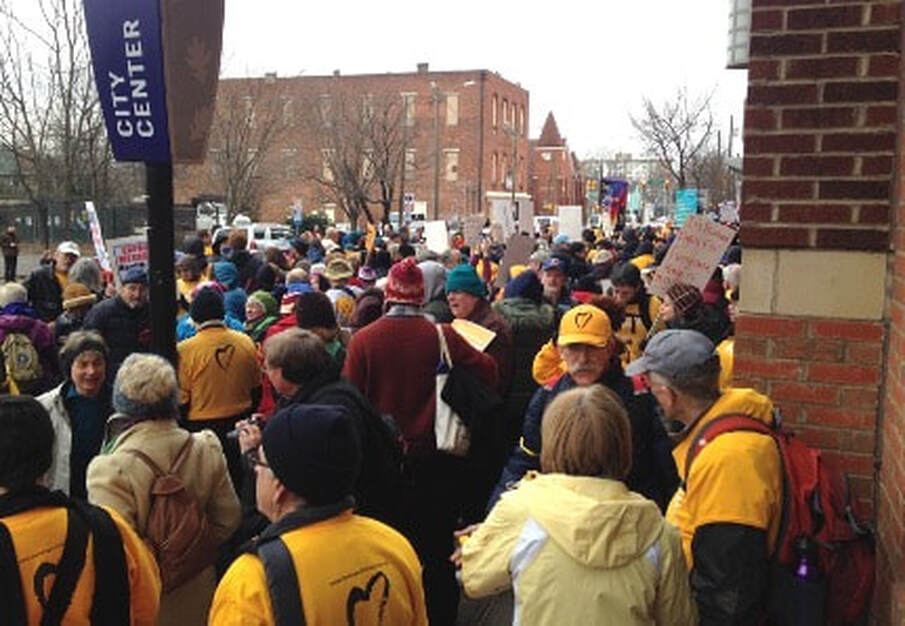
Higher GroundThere we were, five UUs from the Unitarian Universalist Church in Washington Crossing, standing among 1,500 other UUs from all over the nation, ready to march in Raleigh NC on Feb. 8 along with 80,000 others who showed up to support justice and democracy.
Judith MacLaury, Connie Rafle, Peter Rafle, and Mike Wilson had traveled to NC along with me to represent UUCWC, New Jersey, and Unitarian Universalism at the “Moral March,” the largest civil rights march in the South since the 1965 march from Selma to Montgomery. We found in North Carolina a profoundly moving story of struggle, hope, and inspiration. Rev. Dr. William Barber, President of the North Carolina NAACP, began in 2006 to shape a “fusion coalition” of diverse groups that would speak with one voice to the North Carolina legislature. The message: stand on the side of love. The method: democracy. As Barber said at Saturday’s march, “Justice is what love looks like in public.” We UUs embrace as a foundational principle the inherent worth of every human person. Whatever our individual theological beliefs, we unite around that basic principle. It means we celebrate diversity, encourage one another’s lifelong personal growth, and work to create conditions that allow every human being to live in dignity and freedom. The inherent worth of every person is the idea at the center of the fusion coalition. It’s the principle behind “one person one vote.” It’s why groups supporting causes like universal health care, marriage equality, reproductive rights, environmental justice, worker’s rights, educational funding, and food stamps have joined together in the Moral March movement. It’s why the Moral March is moral. Weaving together biblical tradition and the US Constitution, Rev. Barber invited people everywhere to set aside petty differences and unite around human well-being as the touchstone for government policy and legislative change. He called us to “higher ground.” As the song says, “I’m on my way….” Watch Rev. Barber’s “Higher Ground” speech on YouTube (he starts at 0:39:24). 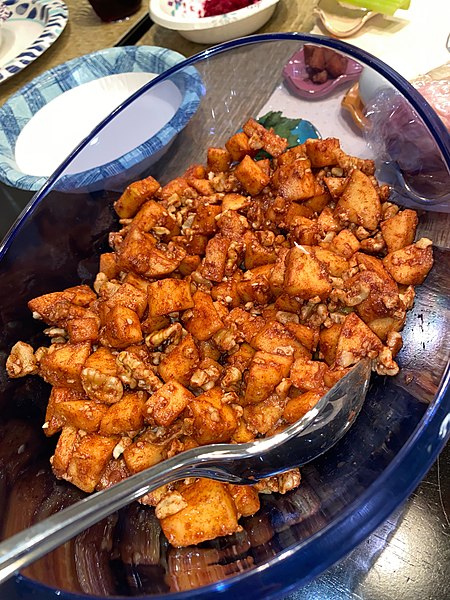
CharosetFor the UUCWC Seder this year (April 18, 2014), I ventured to make charoset, the traditional Passover fruit-and-nut dish. This was not a chefly impulse; I resist those. Instead I was inspired by Rabbi Arthur Waskow’s message about charoset as “The Seder’s Innermost Secret” (https://www.jewishjournal.com/eco-rebbe). I loved the idea that the Song of Songs, that gorgeous love poem, had in it an ancient recipe for a traditional food served through the ages at every Passover Seder.
So, beginner’s luck, it worked. Here’s the recipe. 3 medium apples, diced (with skin) ¾ cup of raisins (three of those little boxes) ½ cup of dried apricots, diced 8 figs (more would be OK, too), diced ¾ cup finely chopped walnuts ¼ cup cinnamon 2 T cardamom 2 T date sugar (finely ground dates) ½ cup grape juice (or enough to dampen the other ingredients) Not incidentally, but rather to my surprise, I was able to use the info in Arthur’s post to craft a “Time for All Ages” that celebrated both Passover and the generous gifts of the Earth (while omitting the more adult aspects of Arthur’s message). The kids had fun contributing the ingredients to a communal dish and some of them may even have been inspired to try charoset at the Seder. |